Frequently Asked Questions (FAQ)
FAQ about Eclipse Glasses and Solar Observation Safety
When should I buy eclipse glasses?
We strongly recommend buying your solar eclipse glasses several weeks before any upcoming eclipse.
As the event approaches, demand rises exponentially, and many people try to place last-minute orders. This surge often causes shipping delays and logistical bottlenecks, preventing glasses from arriving on time.
Additionally, suppliers may run out of stock since inventory depletes quickly in the days leading up to the eclipse. Once this happens, finding certified glasses from trusted sources can become difficult—or even impossible.
To guarantee your safety and peace of mind, we recommend securing your glasses early and avoiding last-minute stress.
Preparing in advance ensures timely delivery and gives families with children the chance to practice safe eclipse viewing ahead of time.
How can I verify that eclipse glasses are authentic?
Fake eclipse glasses can be extremely dangerous because they may not block harmful solar radiation.
Always buy your eclipse glasses from reliable, established brands like Spectrum.
While many suggest looking for the ISO 12312-2 certification logo printed on the glasses, this label can be counterfeited.
A more reliable guarantee of safety is to purchase glasses from a brand with a proven track record of compliance and transparency.
At Spectrum, all our eclipse glasses are:
- Independently tested and certified in both the manufacturing and sales countries.
- Fully compliant with ISO 12312-2 and CE EN 169/1992 standards.
- Accompanied by publicly accessible lab reports.
Do eclipse glasses expire?
Technically, no—if they are undamaged and have been stored properly.
If your glasses meet the ISO 12312-2 standard and the lenses have no scratches, holes, or visible damage, they can be reused indefinitely.
That said, we recommend caution. Over time, improper storage or use can cause micro- damage not visible to the naked eye. For this reason, many sources advise discarding glasses that are over 3 years old.
When in doubt, the safest option is to replace them.
How should I store my eclipse glasses?
To prolong the life of your eclipse glasses, follow these tips:
- Store them flat in their original packaging, a protective envelope, or a ziplock-style
plastic bag. - Keep them in a cool, dry place, away from direct sunlight and heat sources.
- Do not fold or crease them, as this can damage the solar filter.
A surprisingly effective storage spot? The fridge (inside a sealed bag), where temperatur and humidity stay low.
Can eclipse glasses be cleaned?
We recommend not cleaning them unless absolutely necessary. If you notice dust or smudges:
- Use a dry, soft, lint-free cloth to gently clean the lenses.
- Never use water, solvents, or cleaning products.
- Keep the cardboard frame completely dry; moisture can warp it or loosen the lenses.
Are Spectrum glasses safe for children?
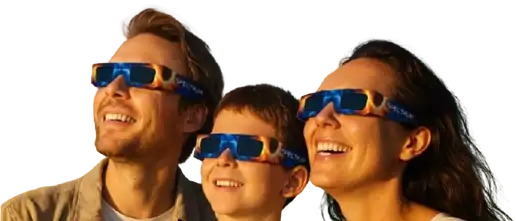
Yes! Spectrum eclipse glasses are designed to fit securely on both adults and children.
However, children should always use them under adult supervision.
If you’ll be watching an eclipse with small children, practice indoors beforehand so they lear
how to wear them correctly.
When is it safe to look at the Sun during a solar eclipse?
Total solar eclipses:
You must use certified eclipse glasses at all times except during the brief moment of totality—when the Moon completely covers the Sun—at which point you can look directly
without protection.
As soon as the Sun begins to reappear, put your glasses back on.
There are misconceptions about totality: some people believe there are still harmful rays, but this is false.
During totality, the Sun’s bright photosphere is completely blocked, and only the faint corona is visible, whose light is not harmful to the eyes.
Partial and annular eclipses:
You must use eclipse glasses at all times, even at maximum coverage, since part of the Sun
remains visible.
How long can you safely watch an eclipse?
With eclipse glasses that meet the ISO 12312-2 standard, there’s no strict time limit regarding radiation exposure. However, for comfort and safety:
- Take short breaks to rest your eyes.
- Avoid staring continuously for long periods.
NASA warns that “watching the Sun for several minutes straight, even with proper filters, can overheat eye tissues and fluids.”
Can your eyes be damaged even if only a small part of the Sun is visible?
Yes. Even a tiny exposed fragment of the Sun can cause permanent retinal damage.
The retina’s photosensitive cells (cones and rods) are extremely delicate. During t day, the pupil contracts to limit light, but the Sun’s surface is so bright that even a small fraction can harm your eyes if viewed directly.
Damage can occur even after a quick glance.
- Never look directly at the Sun.
- Always use certified eclipse glasses or proper solar filters.
If you notice any changes in your vision after viewing an eclipse, see an eye care professional
immediately.
Does certification guarantee eye safety?
Spectrum glasses are certified to ISO 12312-2 and CE EN 169/1992 standards, meanin they filter harmful solar rays and are safe when used properly.
However, certification alone does not prevent damage if the glasses are misused, damaged, or
improperly worn.
It is the user’s responsibility to carefully follow safety instructions.
Can I use my phone to view or photograph a solar eclipse?
Never look at the Sun through a camera, binoculars, or telescope without a solar filter, eve while wearing eclipse glasses. These devices magnify sunlight, can damage the filter, and allow intense light to enter your eyes, causing serious injury.
It is only safe to look at the Sun through these devices if certified solar filters are securely mounted on the front.
Experience a Unique
Solar Eclipse with Spectrum
Spectrum eclipse glasses are ISO certified with cool designs and great prizes!
Experience a Unique
Solar Eclipse with Spectrum
Spectrum eclipse glasses are ISO certified with cool designs and great prizes!